

For Clinicians
Professional Trainings
Live continuing-education intensives and trainings for licensed clinicians.

A NEW MEMOIR BY DR. NIKI SERRAVALLE
The memoir of a psychologist who knew the signs and stayed anyway.
Live virtual launch party
Thursday, November 12 | 7:00 PM ET
CFBL Institute
Clinically rigorous training in trauma-informed practice, psychological assessment, and applied clinical reasoning, taught by a practicing psychologist.

Explore the Institute
For Clinicians
Live continuing-education intensives and trainings for licensed clinicians.

Go Deeper
Multi-session courses and certification tracks that build clinical skill over time.

Practical Learning
Clinician-led workshops offering practical tools and reflective learning.
Not a book club. I have already read these. Each subject gets a shelf and each week gets one book: what it gets right, what to hold loosely, and whether it belongs on your shelf.
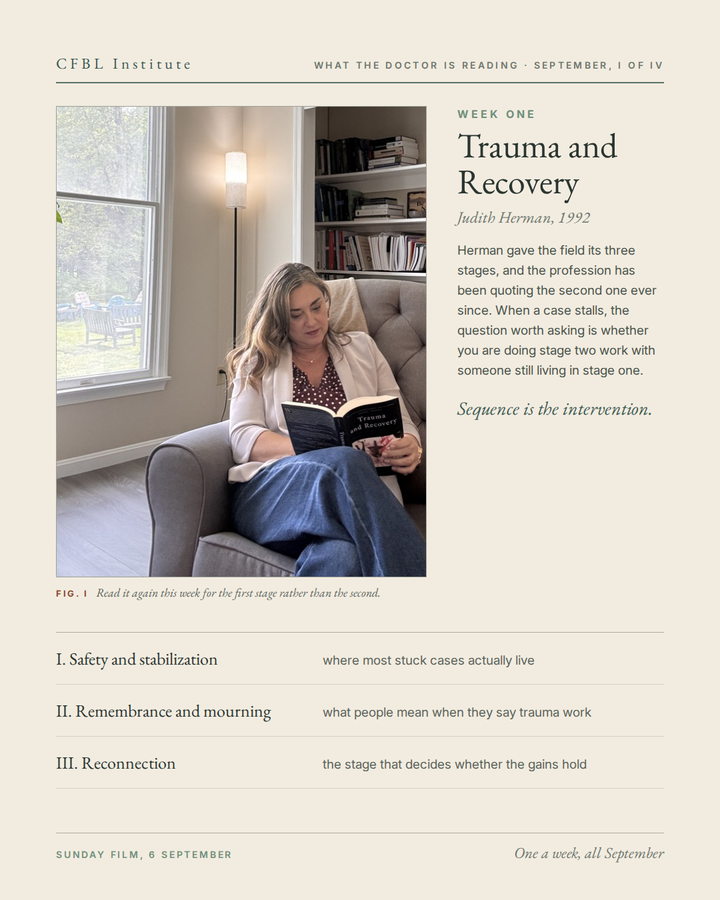
Film on Sunday, September 27
Judith Herman, 1992
Why read it
Herman called stage one safety and stabilization. We have newer language for it now, but the clinical problem she identified has not changed. Stage one is not teaching coping skills so that we can get to the work. It is the work. Most stuck cases are stage one problems being treated as stage two.
Worth knowing
Many clients with complex histories can begin processing sooner than a strict phase model suggests (de Jongh et al., 2016).
Best for
Clinicians early in trauma work, and anyone whose cases keep stalling once processing begins.
Where its central claim sits
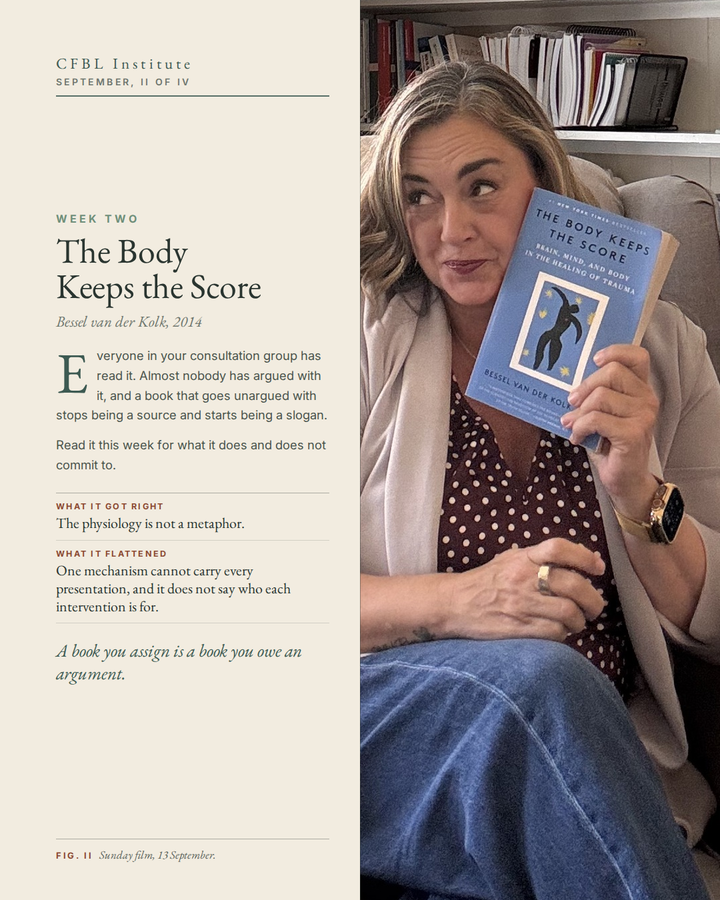
Film on Sunday, October 4
Bessel van der Kolk, 2014
Why read it
It moved trauma beyond the idea that suffering lives only in thoughts and memories, and it made the body impossible to ignore. Still worth reading. Also worth arguing with.
Worth knowing
The body carries patterns rather than stored files, and those patterns look different in every client. The book draws on polyvagal theory, which research is still testing (Grossman, 2023).
Best for
Clinicians who need the body in the case conceptualization. Read it alongside a critique.
Where its central claim sits
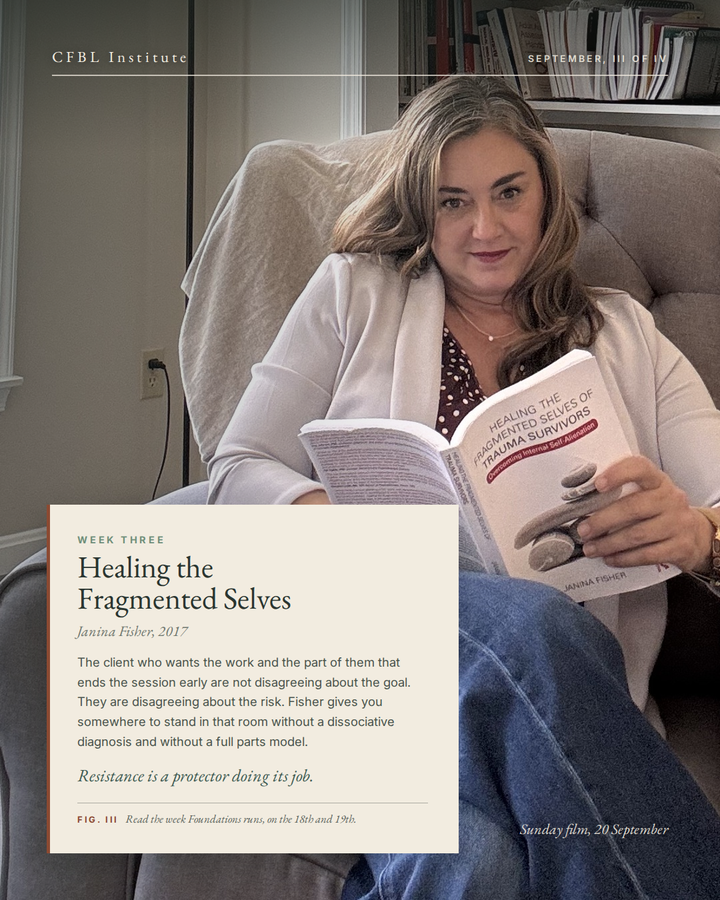
Film on Sunday, October 11
Janina Fisher, 2017
Why read it
Internal contradiction is not necessarily resistance. Fisher gives clinicians a way to work with the client who wants treatment and dreads every session, without turning that into pathology or noncompliance. We stop trying to make one part win.
Worth knowing
Parts language is a useful clinical map. Research on the structure beneath it is still developing.
Best for
Clinicians whose clients seem to get in the way of their own treatment.
Where its central claim sits
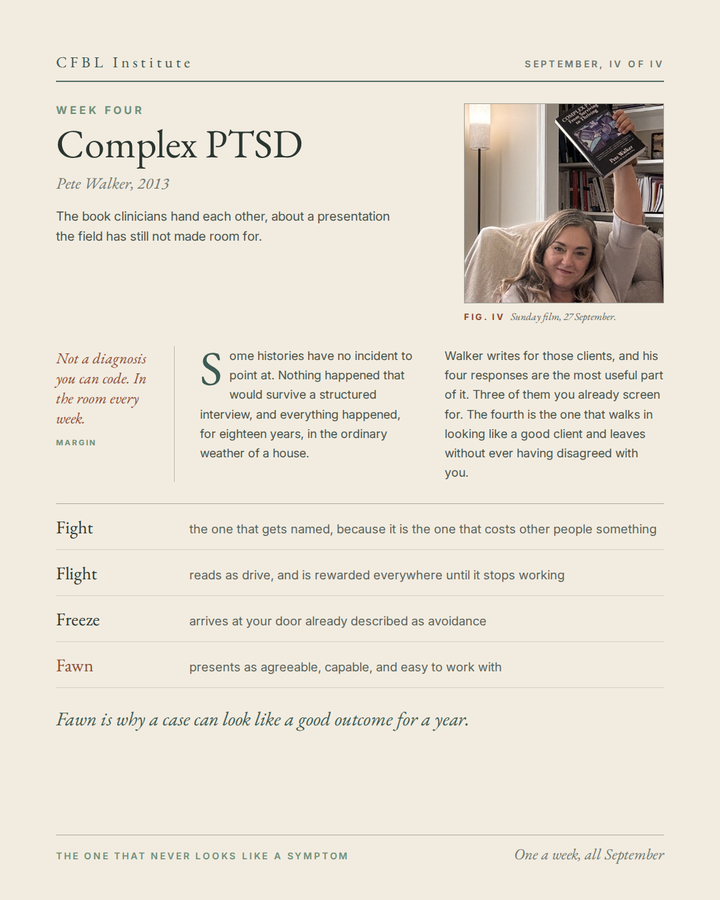
Film on Sunday, October 18
Pete Walker, 2013
Why read it
Some histories have no single event in the timeline. Walker gave us language for emotional flashbacks without a visual narrative: a client suddenly feels very young, ashamed, trapped or defective, and does not know why.
Worth knowing
Not every difficult childhood is a trauma diagnosis. Complex PTSD is recognized in ICD-11, and the fawn response is a newer idea that research is still catching up to.
Best for
Clinicians working with adults whose history is a developmental environment rather than an event. Readable for many clients as well.
Where its central claim sits
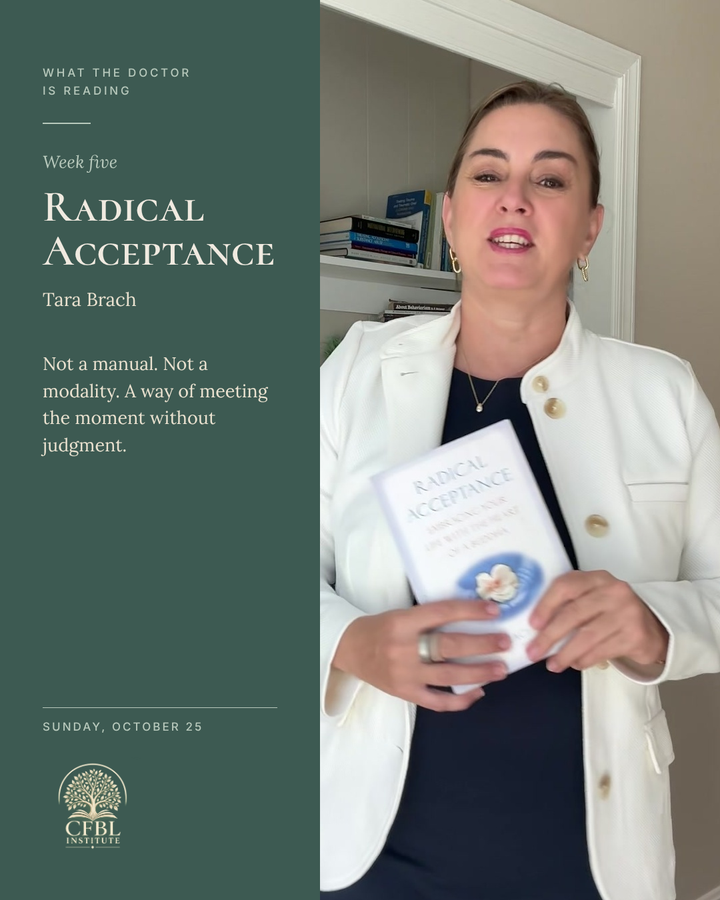
Film on Sunday, October 25
Tara Brach, 2003
Why read it
Not a manual and not a modality. A way of meeting what is here without judgment, which is harder than it sounds and more useful in the room than most techniques. Read it, then practice it.
Worth knowing
It is a practice book rather than a treatment protocol, and its ideas share roots with acceptance-based therapies such as ACT and DBT.
Best for
Clinicians building their own capacity to stay present with what they cannot fix.
Where its central claim sits
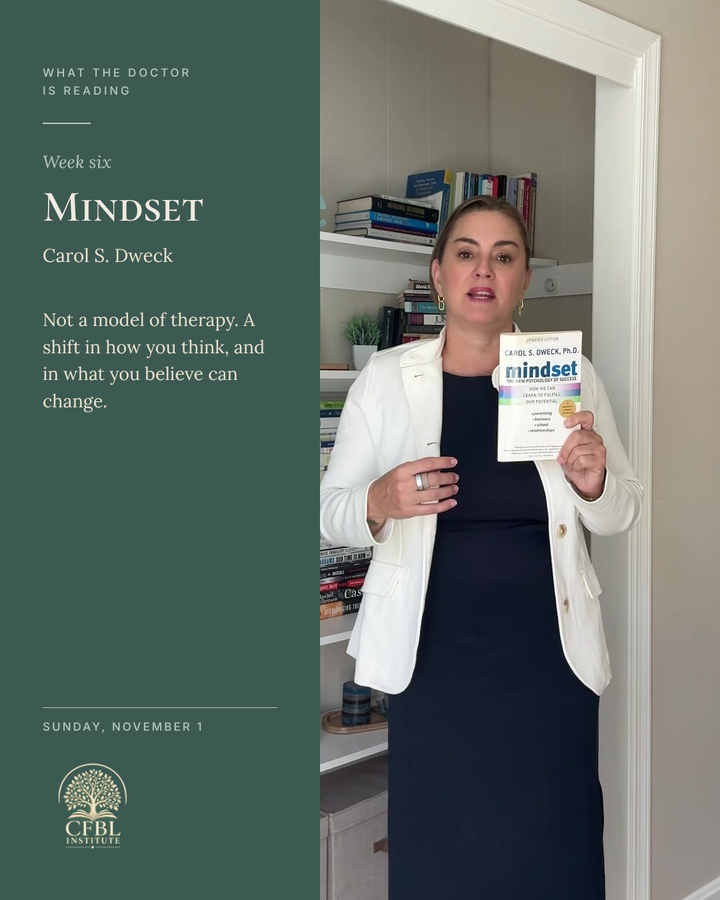
Film on Sunday, November 1
Carol S. Dweck, 2006
Why read it
Not a treatment model. A way of thinking: the shift from a fixed to a growth mindset, and what changes when you apply it to business, sports, health care and relationships.
Worth knowing
Growth mindset research shows real but modest effects, strongest for students who are struggling (Sisk et al., 2018; Yeager et al., 2019).
Best for
Supervisors, educators, and clinicians who coach or teach.
Where its central claim sits
Every book is sorted by where its central claim sits: established, emerging, theoretical, or clinical wisdom. Clinical wisdom is not a dismissal. It is often right and simply has not been tested yet.
Every past subject stays on the shelf. Choose one to bring it back down.

Meet the Trainer
Founded and led by Dr. Niki Serravalle, licensed clinical psychologist and founder of the Center for Balanced Living. CFBL Institute exists to bridge the gap between clinical theory and applied practice. Our work is grounded in trauma-informed science, nervous system awareness, cultural humility, and the lived complexity of real clinical work.
Training is how clinical knowledge moves from one clinician to the next. I teach because the best of what I learned came from clinicians who showed me how they thought, not just what to do. That is the kind of training I try to offer now.
FAQ
Everything to know before you register. Do not see your question here? Reach out and we will answer it.
Our trainings are built for licensed mental health clinicians, including psychologists, LCSWs, LPCs, LMFTs, LMHCs, PMHNPs, and MDs, as well as graduate students in clinical and counseling psychology. Each offering lists the clinical experience it assumes so you can choose the right fit.
Most trainings are delivered live online so you can attend from anywhere, with slides and handouts shared with registrants. Some run as a multi-session series with time to integrate between meetings. The length, schedule, and any pre-work are listed on each training's page.
Registration opens on each training's page once dates are confirmed. When a cohort is full or dates are still being scheduled, you can join the waitlist. Waitlist members hear first and are invited to register before seats open to the public.
Registrants receive a certificate of completion listing the training title, date, and hours attended. A certificate of completion is not continuing education credit. When a program carries CE credit, its page names the approving body. If you have a specific licensing-board requirement, reach out before registering.
Pricing is listed on each training's page and varies by length and format. Reduced student rates are available for many offerings, and we offer group rates for agencies or practices enrolling several clinicians. Contact us for a group quote.
If you need to cancel, let us know as early as you can and we will arrange a transfer or a credit toward a future cohort. If you need an accommodation to take part fully, tell us when you register so we can plan ahead.
Stay in the Loop
Join the Institute list for new trainings, courses, and CE announcements for clinicians. No noise, just the work.
Your email is never shared.
For Clinicians
Reach out about an upcoming training, course, or workshop, or to ask about group rates. We respond to professional inquiries directly.
For brief, non-urgent questions only. Please do not share private health information by text.
By appointment
We usually reach out within 24-48 hours.
This form is not intended for emergencies or urgent mental health concerns. If you are experiencing an emergency, call 911 or go to your nearest emergency room.
For Professionals
Join a cohort or inquire about supervision and consultation.
