
There are at least a dozen recognizable trauma-specific models in circulation. Several are well evidenced. Several are not. All of them are marketed with similar institutional weight, and clinicians develop loyalties that quietly shape treatment decisions. The discipline this intensive teaches is the one that sorts established evidence from emerging evidence from theoretical scaffolding from clinical wisdom, and refuses to collapse them.
The intensive begins with the foundation. The history and ethics of the diagnosis, including what it cost to get it. Diagnostic frameworks and differential reasoning across DSM-5-TR and ICD-11. Neurobiology taught with explicit attention to what the evidence does and does not license you to say. Assessment and case conceptualization. Stabilization and phased treatment.
From there it moves into treatment domains. CPT and PE. EMDR, presented critically. Somatic, parts-based and attachment approaches, with the scope-of-practice line drawn clearly. Complex trauma, dissociation and comorbidity sequencing. Cultural context, including race-based traumatic stress and minority stress, treated as central to formulation rather than as a supplement to it.
Composite case vignettes run through the intensive and are worked in real time. You will build a differential, write a formulation, draft a stabilization plan, and finish by writing your own integrative clinical stance.
Who this is for
Licensed mental health clinicians. Psychologists, counselors, social workers and marriage and family therapists.
Presenter
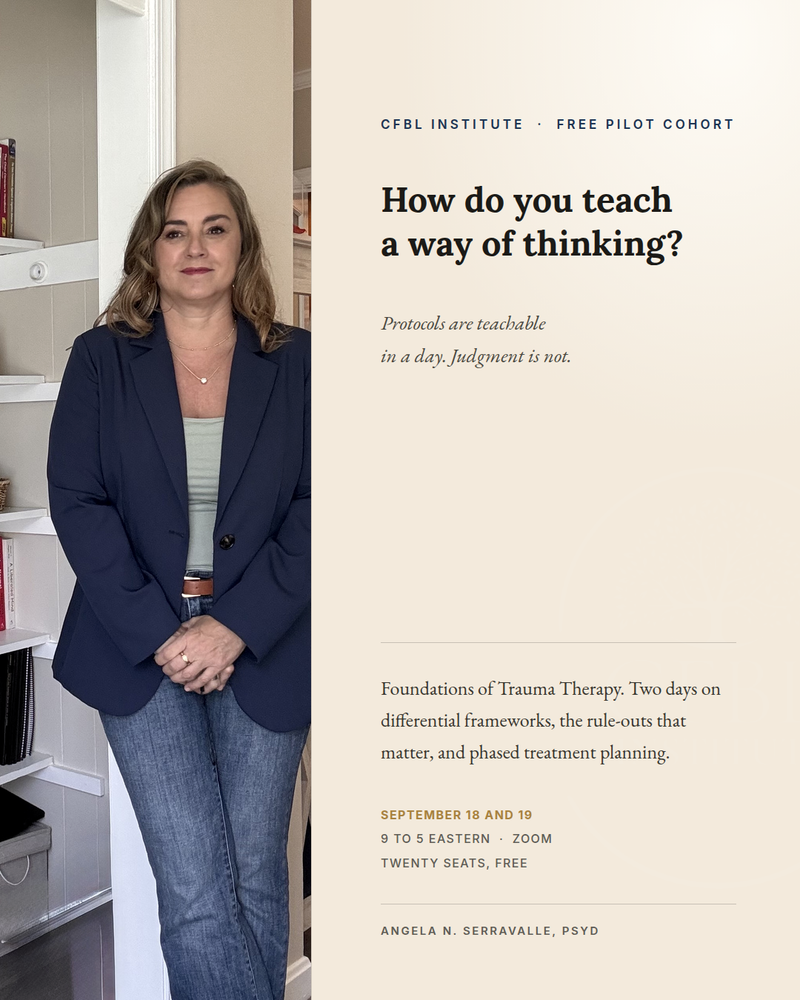
Dr. Niki Serravalle, PsyD, is a licensed clinical psychologist in Delaware. She is EMDRIA Certified, an EMDR Consultant, and an EMDRIA Approved Basic Trainer. She presents EMDR critically in this course, which is the discipline of the material rather than a personal stance.
Next cohort
The pilot cohort ran in September 2026. Based on what that cohort told us, the intensive is being rebuilt as a single-day live virtual format so working clinicians can attend without giving up a weekend.
Dates, continuing education credits, and pricing will be announced to the waitlist first.